> For the complete documentation index, see [llms.txt](https://daton-sarasanalytics.gitbook.io/daton/llms.txt). Markdown versions of documentation pages are available by appending `.md` to page URLs; this page is available as [Markdown](https://daton-sarasanalytics.gitbook.io/daton/integrations/data-sources/files/sftp-ssh-file-transfer-protocol.md).
# SFTP (SSH File Transfer Protocol)
## About
SFTP is a network protocol that allows users to execute file transfer, file access, and file management on any reliable data stream over the Internet.
## Setup Guide
Stepwise guide to connecting SFTP to your Daton account.
#### **Prerequisites**
* An existing Daton account.
* An SFTP server with valid files (CSV, and TXT).
#### Stepwise Instructions to Integrate SFTP with Daton
#### Integrate SFTP in Daton
1. [Sign in](https://daton.sarasanalytics.com/login) to your existing Daton account.
2. Search for SFTP in the list of Connectors and click on the **'Configure'** button.
3. Provide the necessary **Integration Name** and **Replication Frequency** data and click on the **'Authenticate'** button.\
*Please Note, the **Integration Name** would be used in creating tables for the integration and cannot be changed later.*
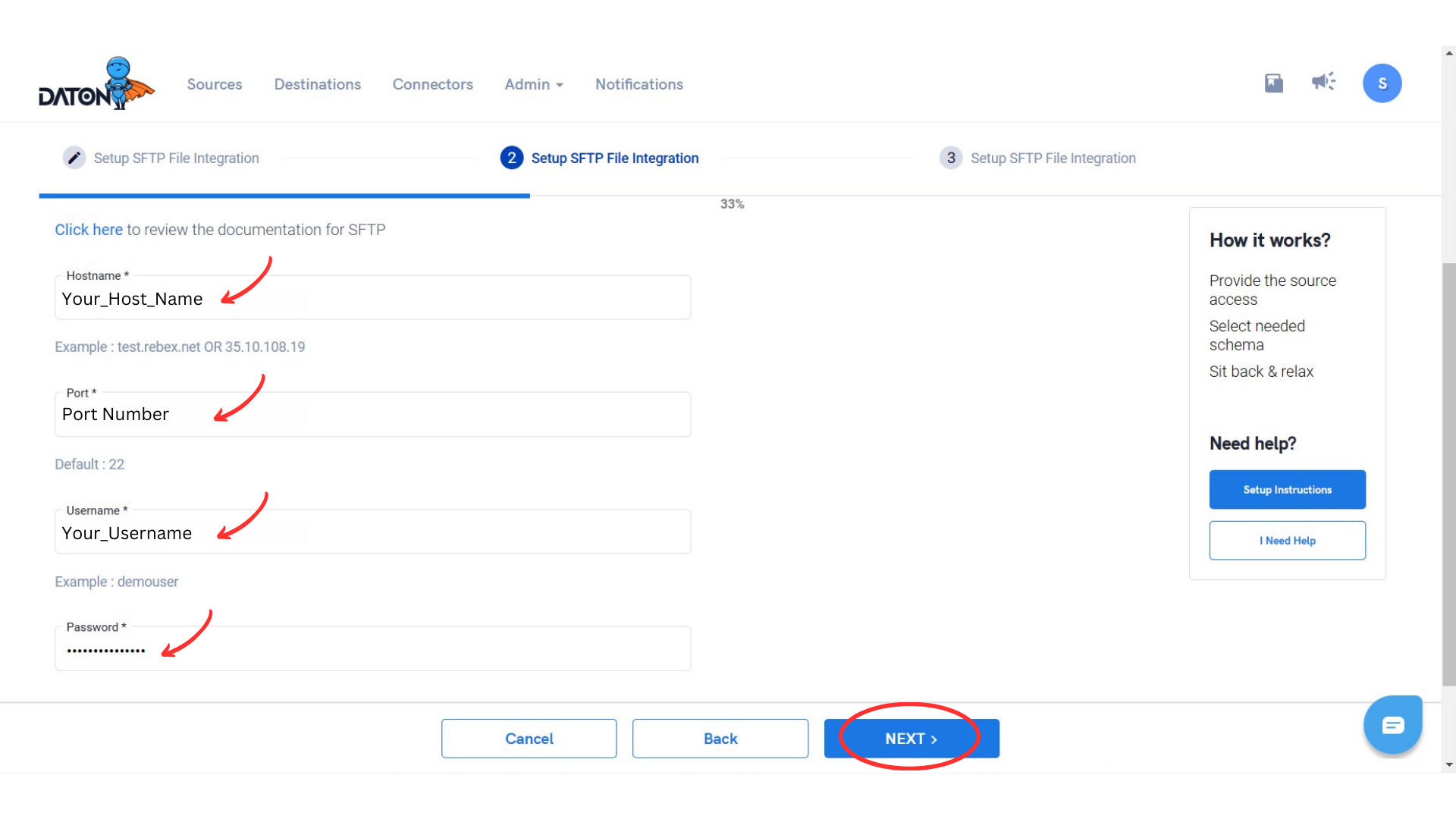
4. Provide an accurate **Hostname, Port number, Username,** and **Password** of the location where the file is stored on your server, then click on the **'Next'** button.
5. In the next step, provide your **Folder Name** (File path), **File Type** (CSV/TXT) and define the row number for the **Header** and click on the 'Submit' button.
6. You will receive a prompt saying your Integration was successful.
Congrats! Your SFTP file has been integrated with Daton.
### Workflow
1. Integrations would be in the Pending state initially and will be moved to the **Active state as soon as the first job loads data** successfully onto the configured warehouse.
2. Users can **Re-Authenticate, Edit, Clone, Pause or Delete** the integration at any given time by clicking on the settings. Users can also edit the integration to **change frequency and history.**
3. Users can **view job status and process logs** from the integration details page by clicking on the integration name from the active list.
4. Files to be processed would be identified with the modified dates of files. \
*If a few records in an existing file get updated, then the entire file would be processed again.*
5. Files present in subfolders from the selected location would not be processed.
6. If new fields are to be added to the files, users must append them to the file, and edit the existing integration in Daton by appending the additional fields for the integration. \
*Daton doesn't support intermittent field additions to a file.*